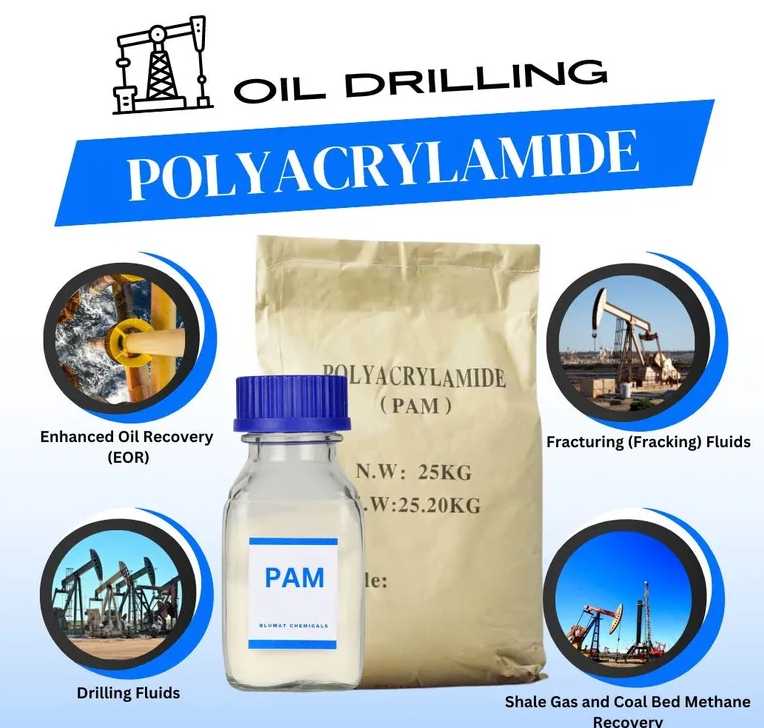
Exploring the Key Applications of Polyacrylamide (PAM) in Oil Drilling
Polyacrylamide (PAM) is a linear polymer with the chemical formula (C₃H₅NO)n. It appears as a white powder or crystalline granules. It is readily soluble in water, and its aqueous solution is a nearly transparent, viscous liquid. PAM possesses excellent flocculation, adhesion, drag reduction, and thickening properties.
PAM can be classified into three types based on ionic properties:
Type | Molecular Weight Range (10,000) | lonic Degree | Applicable pH Range | Main Characteristics |
Anionic (APAM) | 300-2200 | 10-50% | 7-14 | Suitable for neutral/alkaline environments; thickening and flocculation ability |
Cationic (CPAM) | 600-800 | 10-50% | 1-14 | Strong charge neutralization; remarkable decolorization and turbidity removal |
Non-ionic (NPAM) | 500-600 | - | 1-14 | Suitable for acidic conditions; good flocculation effect |
As a "golden additive" in oilfield chemistry, polyacrylamide demonstrates irreplaceable core value in ensuring drilling safety and improving oil recovery.
Anionic Polyacrylamide: Suitable for neutral or alkaline environments, it is the mainstream choice for drilling fluids and oil displacement, possessing excellent thickening and flocculation capabilities.
Temperature- and Salt-Resistant Type: For deep well formations with high temperatures and high salinity, special PAM derivatives can maintain viscosity without decreasing, ensuring operational effectiveness under harsh geological conditions.
Polyacrylamide, often referred to as the "industrial MSG" of oilfield chemicals, is a best-selling product. Please contact Henan Brilliant Biotech Co., Ltd. for more details.
Contact: Janet Zhang
whatsapp:
 Janet Zhang
Phone: +86 17700625486
Tel: 86-371-63370468
Email: info@brilliantchemi.com
Add: No.15 Yinping Road,Zhengzhou,China